Prelude: The Architecture of Divine Wisdom
In the vast tapestry of human spiritual inquiry, certain truths emerge across cultures and epochs with such striking consistency that they transcend the boundaries of geography, language, and time. These are not mere coincidences or parallel evolution of thought—they are the fundamental frequencies of existence itself, vibrating through different cultural instruments, producing varied melodies that share the same underlying harmonic structure. When we examine the mythological and spiritual frameworks of ancient Egypt, Vedic India, and Judeo-Christian tradition, we discover not separate teachings but rather different languages attempting to articulate the same ineffable mystery: the nature of consciousness, the illusion of separation, and the primordial force that binds all existence—unconditional love.
Part I: The First Movement—Isis and Osiris as the Sacred Dance of Eternal Life
The Primordial Truth of Death as Illusion
Isis and Osiris stand as humanity’s first great teachers of the most frightening yet liberating truth: death is not an ending but a transformation, a doorway rather than a wall. Their myth, emerging from the banks of the Nile thousands of years before the Common Era, established the foundational understanding that would echo through all subsequent spiritual traditions—that life and death are not opposites but rather complementary phases of a singular, eternal process.
When Set murders Osiris and scatters his body into forty-two pieces across Egypt, we witness not merely fratricide but the archetypal fragmentation that occurs in manifest existence. The One becomes Many. Spirit descends into matter and appears to die, to lose its unity, to become scattered across the landscape of temporal experience. Yet this apparent tragedy contains within it the seed of the greatest teaching.
Isis, in her tireless search and her refusal to accept death as final, embodies the principle of active love as the reconstituting force of the universe. She does not passively mourn—she acts. She searches, she gathers, she remembers, she reassembles. In esoteric terminology, Isis represents the soul’s remembrance of its divine origin, the magnetic force that draws the scattered fragments of our being back toward wholeness.
Love as the Resurrection Principle
The profound theosophical insight here is that Isis resurrects Osiris not through power, not through knowledge, not through ritual alone, but through the animating force of unconditional devotion. When she transforms into a bird and hovers over her husband’s reconstructed body, fanning life back into him with her wings, we witness love literally breathing life into death. This is not metaphor—it is cosmological principle encoded in narrative form.
In Theosophical terms, Isis represents Buddhi (the spiritual soul), while Osiris represents Atma (the universal spirit). Their union produces Horus (the individuated consciousness), who must then do battle with Set (the material principle, ego, separation) to reclaim rightful sovereignty. This is the journey every soul must undertake: remembering its divine origin (Isis’s search), integrating its fragmented experiences (gathering Osiris’s pieces), allowing love to resurrect spirit from matter (the magical revival), and then manifesting divine consciousness in material reality (Horus’s victory over Set).
The Egyptian teaching is unequivocal: eternal life is not something to be achieved in some distant future but is the fundamental nature of reality, accessible through the transformative power of devoted love. Osiris becomes lord of the Duat (the underworld/afterlife) not as punishment but as expanded sovereignty—he now rules both the visible and invisible worlds, teaching us that consciousness transcends the limitations of a single form or lifetime.
Part II: The Second Movement—Rahu and Ketu as the Spiral Staircase of Karma
The Divine Gift Disguised as Punishment
The story of Rahu and Ketu, emerging from the Vedic tradition’s profound understanding of cosmic cycles, presents us with one of the most sophisticated spiritual paradoxes in human wisdom literature. Svarbhanu, the demon who dared to taste immortality, received what he sought—but not in the form he expected. This is the universe’s way: our prayers are always answered, but rarely in the manner our limited ego-consciousness imagines.
When Lord Vishnu’s discus severed Svarbhanu between head and body, creating Rahu (the head, representing desire, ambition, worldly attachment) and Ketu (the tail, representing past karma, spiritual liberation, detachment), the demon achieved true immortality—but at the cost of wholeness. Or so it appears to the unenlightened mind. In reality, this division is the mechanism through which genuine immortality operates in the realm of form.
The Suppression of Heart by Mind: A Civilizational Wound
The profound psychological and spiritual insight embedded in the Rahu-Ketu myth is that we suppress our hearts to use our minds. Rahu, the head without body, represents pure mentality divorced from feeling, intuition, and somatic wisdom. It is the modern condition: thinking without feeling, analyzing without experiencing, planning without presence. Rahu is the voracious consumer who can never be satisfied because, lacking a body, nothing can be digested. This is the human condition under the domination of ego-mind—endless craving with no capacity for fulfillment.
Ketu, conversely, represents the body of past experience, the accumulated wisdom of previous incarnations, our ancestral memory and karmic inheritance. But without the head, without present-moment awareness to integrate and activate this wisdom, Ketu remains dormant potential, unconscious pattern, the compulsion to repeat rather than the capacity to evolve.
The gift—the divine mechanism of immortality—is that these two forces, separated in apparent punishment, actually create the axis of spiritual evolution. In Vedic astrology, the Rahu-Ketu axis shows us the journey of the soul: where we’ve come from (Ketu, South Node, past life mastery) and where we’re going (Rahu, North Node, current life lessons). This isn’t punishment—it’s the methodology of consciousness evolution through embodied experience.
Mortality as Illusion, Reincarnation as Technology
Here we arrive at a cornerstone truth that Vedic philosophy grasped with crystalline clarity: mortality is an illusion created by identification with a single lifetime. The immortality Svarbhanu sought was already his, as it is already ours—not as endless continuation of one personality, but as the eternal nature of consciousness itself, which assumes different forms across multiple incarnations while remaining fundamentally unchanging in its essence.
Theosophy, drawing deeply from Vedic sources, articulates this as the doctrine of reincarnation: the soul (or more precisely, the causal body/higher manas) persists through multiple personalities (lower manas/ego) in different incarnations. Each lifetime is like a bead on a necklace—distinct, individual, yet part of a continuous thread. The necklace is the soul; each bead is a personality. We mistakenly identify with the bead and fear its inevitable dissolution, not recognizing that we are actually the thread.
Rahu and Ketu together represent the complete mechanism of this process: Ketu holds the memories, patterns, and achievements of past incarnations (often unconsciously), while Rahu drives us toward the new experiences, relationships, and lessons we need for continued evolution. The eclipses they cause—those moments when Sun (soul) or Moon (mind) is temporarily obscured—represent the periodic death of ego-identification that allows for rebirth into expanded consciousness.
The teaching is radical in its implications: We already possess immortality. The quest is not to achieve it but to recognize it, to cease identifying with the temporary vehicle (personality) and realize ourselves as the eternal traveler (soul). This recognition doesn’t come through philosophical understanding alone but through the integration of past wisdom (Ketu) with present experience (Rahu), guided by the one force that can reconcile these apparently opposite poles: love.
Part III: The Third Movement—Adam and Eve as the Sacred Polarity of Creation
The Divine Androgyne and the Necessity of Duality
In the Genesis narrative, we encounter yet another articulation of cosmic law, this time through the lens of polarity and the creative principle. Adam and Eve represent not merely the first humans but the fundamental masculine and feminine principles that underlie all manifestation. This teaching, often obscured by literalist interpretation and centuries of patriarchal distortion, contains profound esoteric truth about the mechanics of creation itself.
Adam, formed from the dust of the earth (matter), represents the masculine principle—active, projective, creative force, the doing aspect of divine consciousness. Eve, formed from Adam’s rib (from his very essence), represents the feminine principle—receptive, nurturing, the capacity to receive and give form, the being aspect of divine consciousness. They are not separate entities but complementary expressions of a singular wholeness, which is why Genesis states they are “one flesh”—they are the divine androgyne differentiated into polarity so that creation can occur through their interaction.
The Quest for Knowledge as Necessary Fall
The conventional interpretation portrays the eating of the forbidden fruit as humanity’s great catastrophe, the “original sin” from which we need salvation. But esoteric Christianity, Gnostic traditions, and Theosophical interpretation offer a radically different reading: the “Fall” was not a cosmic accident but a necessary descent into material experience for the purpose of gaining knowledge through direct experience rather than innocent ignorance.
Adam and Eve in Eden represent potential consciousness—innocent, unified with God, but lacking self-awareness, lacking the knowledge gained through experience, lacking the capacity for conscious choice that comes only through knowing both good and evil. They exist in a state similar to the animal kingdom: harmonious, but not self-aware.
The serpent—long associated with wisdom in ancient traditions (the kundalini serpent, the Uraeus of Egypt, the healing serpent of Asclepius)—offers them something profound: “You will be like God, knowing good and evil.” This is not a lie but a promise that will be fulfilled through the entire arc of human evolution. To know as God knows requires experiencing the full spectrum of existence, which means descending into duality, into the realm where good and evil, pleasure and pain, life and death appear as opposites.
The Alchemical Marriage of Thinking and Feeling
The theosophical principle embedded here is that true knowledge—gnosis—comes not from pure intellect alone nor from pure emotion alone, but from the integration of thinking and feeling, masculine and feminine, creating and receiving. Adam (masculine principle) must learn to receive, to be vulnerable, to feel. Eve (feminine principle) must learn to act, to assert, to think. Only through their interaction in the crucible of material existence can they—and we—develop the synthesized consciousness that genuinely reflects divine knowing.
“To know everything you must think and feel. You must create and receive through the human experience.” This is the alchemical formula: Consciousness (thinking) + Love (feeling) = Wisdom. The tragedy is not that Adam and Eve sought knowledge but that humanity has spent millennia divorcing these principles from each other—developing intellect without heart, or emotion without discernment.
The human experience—with all its suffering, confusion, and apparent separation from God—is not punishment for seeking knowledge but rather the very method by which divine consciousness experiences itself, knows itself, and ultimately returns to itself enriched by the journey. As Teilhard de Chardin would later articulate: “We are not human beings having a spiritual experience; we are spiritual beings having a human experience.”
The Expulsion as Initiation
The expulsion from Eden is not divine rejection but cosmic necessity. You cannot learn to swim while standing on the shore. To truly “know good and evil” requires leaving the garden of innocent unity and entering the wilderness of differentiated experience. The angel with the flaming sword guarding Eden’s gates doesn’t keep us out through punishment—it prevents premature return. We cannot go back to unconscious unity; we must journey forward to conscious reunion.
The promise woven into the curse—that Eve’s seed would crush the serpent’s head—is the guarantee that this descent into matter, into knowledge through experience, has a redemptive arc. The very force that led to the Fall (the quest for godlike knowledge) contains within it the path of return (wisdom through integrated experience). We leave the garden as children; we return as realized beings, conscious co-creators rather than innocent dependents.
Part IV: The Fourth Movement—Christ as the Incarnation of the Teaching Itself
Love Embodied: The Word Made Flesh
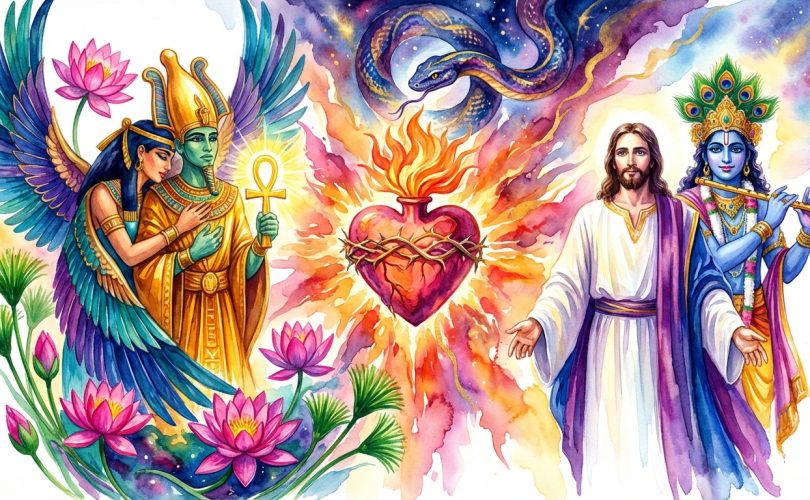
With the advent of the Christ principle—whether understood as the historical Jesus or as the eternal Christ consciousness—we encounter the convergence point of all previous teachings. Christ represents the integration of everything Isis and Osiris taught (eternal life through love), everything Rahu and Ketu embody (transcendence of mortality through conscious evolution), and everything Adam and Eve symbolize (unified consciousness that thinks and feels, creates and receives).
The statement “died for our sins” has been tragically misunderstood through centuries of theological distortion. The “original sin” was not the desire for knowledge but the fragmentation of consciousness that resulted from descending into material experience without the unifying principle of unconditional love. This is the true meaning of separation from God—not punishment, but the natural consequence of identifying solely with the isolated ego rather than with the universal Self.
The Teaching of Unconditional Love as Evolutionary Catalyst
Jesus’s core teaching, often obscured by later doctrinal accretion, was radically simple and radically difficult: Love unconditionally. “Love your enemies.” “Judge not.” “Forgive seventy times seven.” “The kingdom of God is within you.” These are not moral platitudes but operating instructions for consciousness evolution.
Unconditional love is the solvent that dissolves ego boundaries. It is the force that reconnects the fragmented pieces (Osiris’s dismemberment). It is the power that integrates past and present (Rahu and Ketu). It is the wisdom that synthesizes masculine and feminine, thinking and feeling (Adam and Eve). Unconditional love is not a virtue among virtues but the fundamental nature of divine consciousness expressing through human vehicles.
When Christ says “I am the way, the truth, and the life,” the esoteric meaning is not sectarian exclusivity but universal principle: The way is love. The truth is love. Life itself is love expressing in manifest form. Christ consciousness is not the property of one man or one religion—it is the awakened state available to all humans when they transcend ego-identification and recognize their fundamental nature as expressions of divine love.
The Crucifixion: Humanity’s Rejection of Its Own Salvation
Here we confront the most devastating pattern in human spiritual history: when unconditional love appears in manifest form, we kill it. This is not metaphor or exaggeration—it is observable historical and psychological fact. The crucifixion of Christ is the archetypal expression of humanity’s response to the very teaching it claims to seek.
Why? Because unconditional love threatens every structure of ego, every system of control, every hierarchy of power that human society constructs. Ego thrives on conditions: “I will love you if…” “I am valuable because…” “We belong and they don’t…” Unconditional love dissolves all these boundaries. It equalizes the powerful and the powerless. It forgives the unforgivable. It includes the excluded. It loves without requiring worthiness. This is absolutely terrifying to every aspect of human consciousness still identified with separation.
The “sin” that Christ died for—the true sin that perpetuates human suffering—is our inability to comprehend and embody unconditional love, our fear of the very liberation we claim to desire. We didn’t have the knowledge yet because knowledge is not information—it is lived experience, integrated wisdom. Humanity has not yet collectively graduated from conditional love (you are valuable if you meet my standards) to unconditional love (you are valuable because you exist). This is the evolution of consciousness that all the great teachings point toward.
The Passion as Initiation Template
The crucifixion, death, and resurrection of Christ recapitulates the Isis-Osiris pattern at a more individualized level. Christ, like Osiris, must “die” (descend into the tomb of matter, face the full force of human hatred and fear) in order to demonstrate that love is stronger than death, that consciousness survives the dissolution of the body, that the resurrection principle operates at all levels of existence.
The three days in the tomb represent the dark night of the soul that every awakening consciousness must traverse—the period when all previous certainties have dissolved but new understanding has not yet crystallized, when we are in the underworld between the death of the old self and the birth of the new. The resurrection demonstrates that what appears as death to ego-consciousness is actually transformation to soul-consciousness.
The promise of “eternal life” through Christ is not pie-in-the-sky afterlife compensation but the recognition that we already are eternal beings temporarily inhabiting mortal forms. Christ shows the way through identification with ego-personality (death of the lower self) to identification with divine consciousness (resurrection of the higher Self). This is precisely what Isis and Osiris taught, precisely what Rahu and Ketu facilitate, precisely what Adam and Eve’s journey ultimately leads toward.
Part V: The Fifth Movement—Krishna as the Eastern Mirror of the Same Truth
The Convergence of Wisdom Traditions
That Krishna and Christ taught essentially the same doctrine of unconditional love is not coincidence but confirmation of universal truth emerging through different cultural matrices. When vastly different civilizations, separated by geography and history, independently arrive at identical core teachings, we are not witnessing cultural transmission but the recognition of fundamental reality by evolved consciousness.
Krishna, in the Bhagavad Gita and throughout his earthly manifestation, embodies and teaches the same principle: “Abandon all varieties of religion and just surrender unto Me” (Gita 18.66)—not unto Krishna as personality but unto divine love as the unifying principle of existence. His teachings on karma yoga (selfless action), bhakti yoga (devotional love), and jnana yoga (knowledge through discernment) all point toward the integration of thinking and feeling, doing and being, individual and universal consciousness.
The Beheading of Shishupala: The Merciful Severance
The story of Krishna beheading Shishupala, splitting one being into two, directly mirrors the Vishnu-Rahu-Ketu narrative because it is the same cosmological principle expressed through different cultural symbolism. Shishupala, in his relentless opposition and insults toward Krishna (divine love), represents the ego that refuses to surrender, the aspect of consciousness that clings to separation, that insists on autonomy from the divine.
Krishna’s beheading of Shishupala is merciful, not punitive. Like Rahu and Ketu, this division creates the mechanism for evolution: the separation of consciousness (head) from unconscious karma (body) so that they can be worked through across incarnation cycles. Past life patterns (Ketu/body) and current life awareness (Rahu/head) must be gradually integrated through repeated incarnations until love dissolves the illusion of their separation.
The profound insight here is that Krishna, as unconditional love incarnate, gives his opposition the very gift they unknowingly seek: the opportunity to evolve through the reincarnation cycle until they discover that what they were fighting against (surrender to love) is actually what they were fighting for (liberation and wholeness).
The Pattern of Betrayal: Love Confronting Power
Krishna’s entire life story is punctuated by betrayals and assassination attempts: Putana’s poison, Kamsa’s countless murder schemes, Duryodhana’s refusal of peace, the Kauravas’ treachery, and ultimately the hunter’s arrow that kills him (in some accounts, through confusion or mistake—a fitting end for the god of divine play, suggesting even his “death” was conscious choice).
Each of these betrayals represents the pattern of ego-identified consciousness rejecting the love-consciousness that seeks its liberation. Putana represents false nourishment (ego gratification disguised as sustenance). Kamsa represents fear-based authority that sees love as threat to power. Duryodhana and the Kauravas represent the attachment to material kingdom (worldly power and possession) that cannot comprehend Krishna’s offering of true kingdom (consciousness itself).
The Mediation That Failed: The Tragedy of Opportunity Refused
Krishna’s attempt to mediate peace between the Pandavas and Kauravas is one of the most poignant moments in spiritual literature. Here we see unconditional love attempting to prevent catastrophic conflict through reason, compromise, and appeal to higher principles—and we see it rejected in favor of ego-gratification, greed for territory, and the illusion of power through domination.
What happens to love when trust is betrayed? The question carries profound spiritual weight. Does love withdraw? Does it turn to hatred? Does it become conditional? Krishna’s response shows the true nature of unconditional love: it does not withdraw or retaliate, but it also does not prevent the natural consequences of choices made. When humans insist on learning through suffering rather than through wisdom, love allows that learning—not because it is punitive, but because free will is sacred and consequences are the universe’s teaching mechanism.
The Bhagavad Gita, delivered on the battlefield before the great war, represents Krishna’s teaching at the moment when humanity’s rejection of peace-through-love makes conflict inevitable. Even here, in the midst of necessary violence, the teaching remains love-centered: Act without attachment to outcome. Do your duty but offer all actions to the divine. See the eternal Self in all beings, even those you must oppose. This is the mature spirituality that recognizes love sometimes expresses through boundaries, through saying “no,” through allowing others to experience the consequences of their choices.
Part VI: The Wound at the Heart of Humanity—Why We Kill What We Need Most
The Primal Fear: Love as Annihilation of Ego
We arrive now at the core diagnosis of the human condition: We fear unconditional love more than we fear death itself, because unconditional love is the death of ego-identity. The ego—that constructed sense of separate self, that story we tell about who we are—cannot survive in the presence of true unconditional love. Ego thrives on conditions, on boundaries, on hierarchies, on the illusion of control. Unconditional love dissolves all of these.
When authentic love appears—whether in the form of Christ, Krishna, Buddha, or any genuinely awakened being—the ego experiences this as existential threat. Not consciously, perhaps, but at the deep structural level where our sense of separate identity is maintained. This is why we kill the avatars, betray the masters, twist the teachings, and institutionalize the very wisdom that was meant to liberate us.
The historical pattern is clear and tragic:
- Christ taught love; Christianity often practiced judgment and exclusion
- Buddha taught non-attachment; Buddhism developed elaborate hierarchies and possessive monasticism
- Muhammad taught unity and compassion; Islam splintered into sects that fought each other
- Krishna taught transcendence of ego; Hinduism created rigid caste systems
- Moses brought commandments against murder; they were used to justify genocide
This is not coincidence or unfortunate deviation. This is the predictable response of ego-consciousness encountering that which would dissolve it. Rather than undergo the death and rebirth that genuine spiritual transformation requires, we capture the teaching, institutionalize it, make it safe, make it conditional, and use it to reinforce the very structures of separation and control that it originally opposed.
Fear as the Easy Path: Why We Choose Suffering Over Liberation
“It is easier to fear than it is to love.” This simple statement contains profound psychological and spiritual truth. Fear is the natural response of ego-consciousness, which perceives itself as separate and therefore vulnerable. Fear requires no transformation—it reinforces existing patterns of contraction, defensiveness, and self-protection.
Love—authentic, unconditional love—requires ego-death. It requires surrendering the illusion of separate self, opening to vulnerability, trusting in fundamental benevolence of existence even when surface experience shows suffering. This is terrifying to the constructed identity that has invested everything in maintaining its separateness, its specialness, its control.
So we choose fear. We choose to believe in scarcity rather than abundance. We choose to see others as threats rather than as reflections of ourselves. We choose to hoard rather than share. We choose to control rather than trust. We choose to judge rather than accept. We choose to separate into “us” and “them” rather than recognize the One appearing as many.
And because fear is easier, because ego-preservation is the path of least resistance, the great teachings get perverted into their opposites:
- Love becomes conditional: “God loves you if you believe correctly”
- Peace becomes war: “We must kill them to defend our holy truth”
- Abundance becomes scarcity: “There isn’t enough, so we must take from others”
- Unity becomes hierarchy: “We are chosen/saved/special; they are not”
- Freedom becomes control: “Submit to our interpretation or face punishment”
- Wisdom becomes dogma: “Don’t question, just obey”
The Illusion of Power Through Separation
The ego makes a fundamental error in metaphysics: it believes that power comes through separation, through being different from and better than others. This is the illusion that drives all human violence, greed, and suffering. We believe we gain by others’ loss. We believe our group’s elevation requires another group’s diminishment. We believe power comes through domination rather than through unity.
The great spiritual teachings all point to the opposite truth: True power comes through recognition of unity, through the dissolution of boundaries between self and other, through love that sees the One in all manifestations. This is not weakness but strength of a different order—the strength that comes from alignment with reality rather than resistance to it.
But this truth threatens every power structure built on separation: economic systems that require winners and losers, political systems that require us-versus-them, religious systems that require saved-versus-damned, social systems that require hierarchy and inequality. So we twist the sacred words and use them to justify the opposite of what they teach, claiming divine sanction for human power-seeking.
The accumulation of material wealth gets justified by selective scripture. The oppression of others gets rationalized through claims of divine election or spiritual superiority. The rejection of the outcast gets sanctified through doctrines of purity and righteousness. Fear becomes sanctified, separation becomes holy, and the religion that was meant to liberate consciousness becomes yet another prison of ego-identification.
Part VII: The Cycle Repeats—History as the Classroom We Keep Failing
The Spiral of Collective Karma
“Having history repeat itself time and time again because we refuse to learn.” This is not moral failure but developmental stage. Humanity as a collective undergoes the same evolutionary journey that individuals do—from unconscious unity (Eden) through the experience of separation (the Fall, exile, incarnation) toward conscious reunion (resurrection, enlightenment, moksha).
We are currently, as a species, in the adolescent phase: we have the power of knowledge (Adam and Eve’s fruit) but not yet the wisdom of integrated consciousness (Christ consciousness, Krishna consciousness, Buddha consciousness). We can split atoms but haven’t yet integrated our own psyches. We can manipulate genes but haven’t yet understood the genetic code of consciousness itself. We have thinking without feeling, power without wisdom, knowledge without love.
This is why the pattern repeats:
- A realized being appears teaching unconditional love, unity consciousness, the dissolution of ego-separation
- Initial disciples understand through direct transmission and embody the teaching
- Subsequent generations systematize and institutionalize, gradually losing the living essence
- The institution becomes a power structure that inverts the original teaching
- Eventually the corruption becomes so severe that a new teaching/teacher emerges to reset the cycle
This is not failure—it is the evolutionary spiral. Each cycle, humanity integrates slightly more. Slavery was once universal; now it’s legally abolished (though economically persistent). Women’s oppression was once unquestioned; now equality is at least an acknowledged ideal. Tribal warfare was once constant; now we have international law. We are learning, but learning through painful repetition because we resist the direct path of conscious transformation through love.
Why We Refuse to Learn: The Comforts of Unconsciousness
Why do we refuse to learn? Because learning requires changing, and changing requires death of the old self. It is more comfortable to repeat familiar patterns, even suffering ones, than to surrender into the unknown of transformation. This is true individually (we stay in toxic relationships, addictions, self-destructive patterns) and collectively (we perpetuate war, inequality, environmental destruction despite knowing better).
The teaching of unconditional love is always available. It appears in every generation, every culture, every tradition. The teaching is not hidden—we hide from it. We hide behind complexity, behind theology, behind moralism, behind judgmentalism, behind fear. We make spirituality complicated so we can avoid the simplicity of its actual demand: Let go of ego. Open your heart. Love without condition. Trust existence.
The Separation: Humanity’s Core Wound
All the myths we’ve examined point to the same event, the same pattern, the same wound: separation. Osiris separated from Isis. Rahu separated from Ketu. Adam and Eve separated from God. Christ separated from humanity through crucifixion. Krishna opposed by those he came to liberate.
This separation is not punishment but the archetypal structure of incarnation itself. To manifest in form requires differentiation. Unity must become diversity. The One must appear as Many. God must “forget” itself to experience itself. This is the divine play (lila), the cosmic game, the reason for manifestation.
But the wound occurs when we forget that the separation is temporary, illusory, for the purpose of experience and learning. We mistake the game for reality, the vehicle for the destination, the personality for the Self, the form for the essence. Then separation becomes suffering. Then diversity becomes conflict. Then the Many forget they are One.
All spiritual teaching—every avatar, every scripture, every practice—exists to heal this wound of separation, to remind us that what appears as Many is actually One, that we are not isolated egos but expressions of unified consciousness, that love is not something we must achieve but something we are when we stop defending against it.
Part VIII: The Synthesis—Toward Integrated Consciousness
The Key That Unlocks All Doors: Unconditional Love as First Principle
We arrive finally at the synthesis, the integration, the answer that all the myths have been pointing toward: The key to eternal life, the secret of existence, the beginning and the end, is unconditional love.
This is not sentiment or emotionalism. This is cosmological principle, the fundamental force of existence. In scientific terms, we might call it the tendency of the universe toward coherence, toward the formation of ever-more-complex unified systems. In theosophical terms, it is Fohat, the intelligent energy that builds forms. In religious terms, it is God. In experiential terms, it is the recognition that arises when ego-boundaries dissolve and we experience ourselves as the unified field of consciousness temporarily experiencing itself as separate forms.
Eternal life is not living forever in one form—it is recognizing that we are the formless consciousness that inhabits all forms. We already have eternal life. We already are immortal. The soul never dies because the soul is not a thing but the eternal witness-consciousness itself, the “I AM” that precedes all identification.
Unconditional love is the direct experience of this truth. When we love unconditionally—without needing the other to be different, without requiring them to meet our needs, without judging them as worthy or unworthy—we temporarily dissolve the ego-boundary that creates the illusion of separation. In that moment, we experience what we actually are: unified consciousness recognizing itself in another form of itself.
The Integration of All Principles
The great teachings are not separate paths but different aspects of a single journey toward integrated consciousness:
From Isis and Osiris we learn: Death is illusion. Love is the force that resurrects and reconstitutes. The fragmented must be gathered. The scattered must be remembered. Eternal life is accessed through devoted, active love that refuses to accept separation as final.
From Rahu and Ketu we learn: We are already immortal. What appears as punishment (division) is actually gift (the mechanism of evolution). Past life wisdom (Ketu) must integrate with current life awareness (Rahu). The suppression of heart by mind must be healed. Reincarnation is not punishment but the technology of consciousness evolution.
From Adam and Eve we learn: Knowledge through experience is necessary. The Fall is not failure but descent into learning. Masculine and feminine, thinking and feeling, creating and receiving must integrate. To know as God knows requires the full journey through duality. The way back to Eden is through, not around, the wilderness of experience.
From Christ and Krishna we learn: Unconditional love is the synthesis of all principles. It is the force that gathers (Isis), the consciousness that integrates (Rahu-Ketu axis), and the wisdom that unifies (Adam-Eve reunion). Love is not passive but actively chooses to see unity even within apparent opposition. The crucifixion and betrayal we witness in their lives is the pattern of ego resisting its own liberation—a pattern we must recognize and transcend.
The Practical Path: How Love Transforms
Understanding these myths philosophically changes nothing if we don’t embody the wisdom experientially. The transformation from conditional to unconditional love is the actual spiritual path, regardless of what religious or philosophical framework we use to understand it:
First movement—Self-love: We must first learn to extend unconditional love to ourselves, which means accepting our shadow, forgiving our mistakes, embracing our humanity with all its imperfection. This is Isis gathering the scattered pieces of Osiris within ourselves.
Second movement—Other-love: We extend unconditional love to those in our immediate sphere—family, friends, community. This is challenging because these relationships trigger our deepest wounds and attachments. This is where we work through the Rahu-Ketu axis, integrating past patterns with present awareness.
Third movement—Universal love: We extend love beyond personal preference to include all beings, even those we find difficult, even those who harm us. This is Christ’s “love your enemies,” Krishna’s seeing the Divine in all beings. This is the integration of Adam and Eve—seeing the masculine and feminine, light and dark, as complementary rather than opposed.
Fourth movement—Love as Being: Finally, we don’t practice love—we recognize that we are love experiencing itself through temporary forms. This is the resurrection, the enlightenment, the moksha. Ego-identification dissolves not through effort but through grace, through the recognition that the small self we’ve been defending never existed as a separate entity.
Why This Matters: The Stakes of Our Current Crisis
Humanity stands at a threshold unprecedented in our history. We possess technological power sufficient to destroy ourselves or to create unprecedented flourishing. The determining factor will not be more technology or more knowledge—it will be whether we can evolve from ego-consciousness (separation, fear, competition) to soul-consciousness (unity, love, cooperation).
Every crisis we face—ecological collapse, nuclear weapons, artificial intelligence, economic inequality, pandemic disease—stems from the same root cause: the operating system of separation consciousness, the belief that we are isolated egos in competition for scarce resources, requiring power-over-others for security.
The solution is not political or technological—these are symptoms, not causes. The solution is the evolution of consciousness from fear to love, from separation to unity, from conditional to unconditional relationship with existence. This is what all the great teachings have been pointing toward. This is the curriculum we keep failing.
The myths we’ve examined are not historical curiosities or primitive superstitions. They are consciousness-evolution technologies, encoding the map of transformation from fragmented ego to unified Self. When we truly understand Isis gathering Osiris, we understand how to integrate our own fragmented psyche. When we truly understand Rahu-Ketu, we understand the mechanism of karmic evolution. When we truly understand Adam-Eve, we understand the necessary journey through duality toward integrated wisdom. When we truly understand Christ-Krishna, we understand that unconditional love is not idealism but ultimate realism, the actual structure of consciousness itself.
Coda: The Teaching That Cannot Be Taught, Only Lived
Beyond Words: The Limitation of Philosophy
There is a profound limitation to this entire exploration: unconditional love cannot be understood conceptually—it must be experienced directly. All the words, all the philosophy, all the mythological analysis amounts to the menu, not the meal. It describes the path but doesn’t walk it. It points at the moon but is not the moon.
The great tragedy and great comedy of spiritual teaching is that the truth cannot be transmitted through words, yet words are the primary medium we use to attempt transmission. The awakened masters know this. They speak knowing that their words will be misunderstood, systematized, turned into dogma. Yet they speak anyway, trusting that those with “ears to hear” will recognize the resonance of truth beyond the limitation of language.
The Practice: Moment-by-Moment Choice
So what do we do with this understanding? How do we embody the wisdom we’ve explored?
We begin where we are, with this breath, this moment, this person in front of us. The grand philosophical vision must be brought down to the intimate particular: Can I love this difficult person? Can I forgive this hurt? Can I trust when everything in me wants to control? Can I open when everything in me wants to close?
Every moment offers the same choice: contract in fear or expand in love. Every interaction gives us opportunity to practice seeing the Divine in the other or to see them as separate, threatening, less-than. Every challenge invites us to respond with the wisdom of the soul or react with the patterns of ego.
The myths teach us that this is not easy. Osiris must be dismembered. Christ must be crucified. Krishna must be betrayed. The ego does not surrender willingly. The journey requires dying to what we think we are so we can discover what we actually are. This is not metaphor—it is the felt experience of ego-dissolution, the dark night of the soul, the crisis that precedes every genuine transformation.
The Promise: What Lies Beyond Fear
But the myths also promise that death is never final when love is present. Osiris resurrects. Christ rises. The fragmented becomes whole. The separated reunites. The journey through the underworld leads not to annihilation but to expanded life.
When we finally surrender the exhausting effort of maintaining ego-separation, when we finally allow ourselves to love without condition, when we finally trust that we are expressions of eternal consciousness rather than isolated mortal forms, we discover what the myths have been teaching all along: We are already that which we seek. We are already whole. We are already home. We were never actually separate from the Divine—we only believed we were, and that belief created the experience of separation.
The promise is not that life becomes easy or suffering disappears. The promise is that we discover the unshakeable ground beneath the changing surface, the eternal Self witnessing the temporary personality, the love that persists beneath fear, the unity that underlies apparent division.
The Invitation: Begin Now
This moment, reading these words, is as good a time as any to begin. The spiritual journey doesn’t require perfect circumstances or complete understanding. It requires only willingness to question the ego’s story of separation and openness to the possibility that love is more fundamental than fear.
One conscious breath taken with awareness of yourself as eternal consciousness temporarily embodied. One moment of seeing another person as a mirror of yourself rather than as separate and other. One decision to respond with love rather than react with fear. This is how transformation begins—not with grand gestures but with small shifts repeated until they become your natural state.
The myths are complete. The teachings are clear. The great souls have shown the way. Now the invitation extends to each of us: Will we continue to repeat the pattern of fear, separation, and suffering? Or will we finally learn the lesson that has been taught across all cultures and all ages?
The key to eternal life is unconditional love.
The beginning and the end is love.
You are that love, temporarily forgetting itself so it can remember itself anew.
Remember.